


 : (+54911) 7213 6798
 About the History of Augusta National Golf Club
After retiring from competitive golf in 1930, Bobby Jones was eager to realize his dream of building a golf course. Following a brief conversation with Clifford Roberts, whom Jones had met several times during the mid-1920s, it was decided that the club would be built near Augusta, Georgia, provided suitable land was available. According to Jones' plans, the course should take advantage of the property's natural features, using the terrain's mounds instead of building too many bunkers.
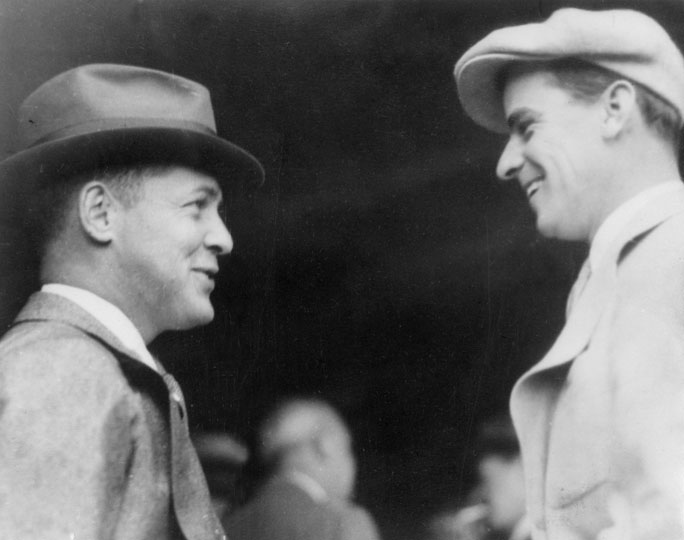
Bobby Jones and Clifford Roberts at the opening of ANGC (January 1933)
It was hoped that the property would have a natural stream to use as a water hazard. Jones wanted this concept of golf course architecture to contribute to the game and express his ideas about design. This club would be open only during the winter season (a tradition maintained to this day).
A mutual friend of Jones and Roberts, Thomas Barrett, Jr., was consulted. He recommended a 365-acre property called Fruitland Nurseries. The property, once an indigo plantation, was purchased in 1857 by Belgian Baron Louis Mathieu Edouard Berckmans, a hobbyist horticulturist. Berckmans' son, Prosper Julius Alphonse, was an agronomist and horticulturist by profession, and the two formed a partnership in 1858. Operating under the name Fruitland Nurseries, the company imported many trees and plants from various countries. The Baron died in 1883. Prosper's death followed in 1910, and the nursery ceased operations by the time its charter expired in 1918. A wide variety of flowering plants and trees, including a long row of magnolias planted before the Civil War and a plant Prosper popularized called the "azalea," remained on the property.
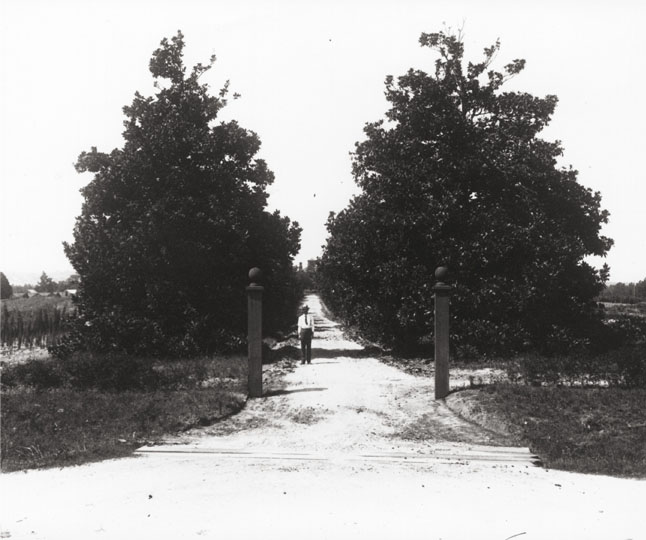
Fruitland Nurseries
Upon seeing the property from what is now the putting green, Jones said: "Perfect! And to think this ground has been here all these years waiting for someone to come along and build a golf course on it." The property was purchased for USD 70,000. It was decided to establish a national membership for the club, and Jones proposed that Augusta National would be an appropriate name.
Jones also decided during the planning stage that he wanted Dr. Alister MacKenzie to serve as the course architect as they shared similar views. Before coming to Augusta, MacKenzie had designed two courses in California, Pasatiempo and Cypress Point. MacKenzie died in January 1934, two months before the first Masters. Construction of the course began in the first half of 1931 and opened in December 1932 with limited play for members. The formal opening took place in January 1933.
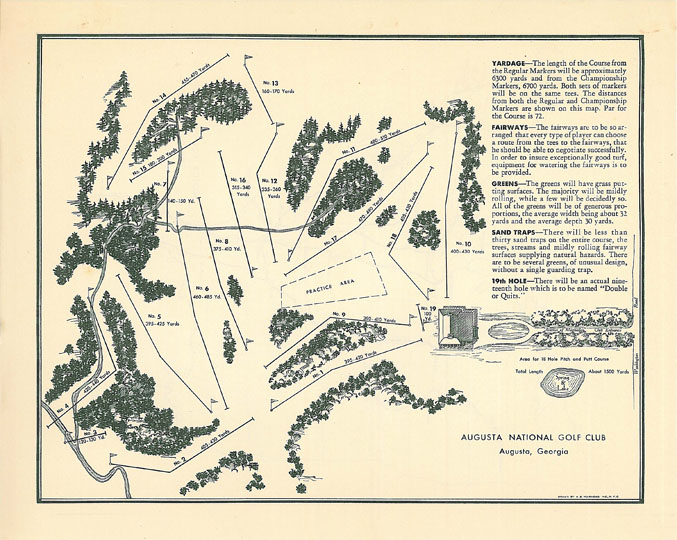
One of the first maps of ANGC
About the holes.
Hole 1 (Par 4, 445 yards, Tea Olive) A hole with a gentle dogleg right that requires a precise second shot toward an undulating green. A poorly executed approach can lead to a difficult two-putt. Drives to the left usually end up in the trees, and the hole plays uphill.
Hole 2 (Par 5, 575 yards, Pink Dogwood) A dogleg left that can be reachable in two. Large, deep bunkers near the green require special attention on the second shot.
Hole 3 (Par 4, 350 yards, Flowering Peach) A classic short par 4. Golfers try to hit before the four fairway bunkers, resulting in a full club toward the green where it is better to be long than short. The green slopes from right to left with a narrow neck on the left side protected by a bunker.
Hole 4 (Par 3, 240 yards, Flowering Crab Apple) A long par 3 that requires a long iron and is often made difficult by tricky winds. Two bunkers near the green protect this forward-sloping green.
Hole 5 (Par 4, 455 yards, Magnolia) An uphill hole dogleg left with a sloping green. The fairway bunkers are deep and positioned to demand accuracy from the tee. The green slopes forward and a rear bunker catches shots that are too long.
Hole 6 (Par 3, 180 yards, Juniper) An elevated tee and defined targets are features of this par 3. A significant difference in elevation from front to back makes pin position very important.
Hole 7 (Par 4, 450 yards, Pampas) The drive on this narrow hole is often played toward the center-left of the fairway, setting up a second shot from a level lie. A short or middle iron can be played from there, but it is important to avoid the three bunkers in front of the green.
No. 8 (Par 5, 570 yards, Yellow Jasmine) A precise drive is needed to avoid the fairway bunker on the right side. This uphill hole presents trouble to the left of the green. Bruce Devlin recorded the second albatross in Masters history here in 1967.
No. 9 (Par 4, 460 yards, Carolina Cherry) Best known for its green that slopes from back to front. The tee shot is often toward the right side in hopes of avoiding the two bunkers near the green on the second shot.
No. 10 (Par 4, 495 yards, Camellia) A long downhill par 4. Players will try to take the ball toward the left or center of the fairway to hit a second shot toward a green that slopes from right to left. Before 1935, this was the 1st hole at Augusta National and is the hardest hole on the course.
No. 11 (Par 4, 505 yardas, White Dogwood) Amen Corner begins at this hole, and the wind is often a factor. The ideal shot is left to right. The hole plays downhill from an elevated tee. A pond protects the green on the left, and a bunker is strategically located in the center-right. This hole may be best remembered for Larry Mize's incredible chip in the 1987 playoff.
No. 12 (Par 3, 155 yards, Golden Bell) One of the most famous holes in the golf world, and the shortest par 3 on the course. With swirling winds, club selection can vary from a 6-iron to a 9-iron. Rae's Creek in front and three bunkers make hitting the green nearly mandatory. The Ben Hogan Bridge allows golfers to cross the creek.
No. 13 (Par 5, 510 yards, Azalea) A precise tee shot to the center of the fairway will allow a player to go for the green in two if they wish. A tributary of Rae's Creek winds in front of the green, and behind the putting surface are four bunkers. The Byron Nelson Bridge is located at this tee. There are approximately 1,600 azaleas from tee to green.
No. 14 (Par 4, 440 yards, Chinese Fir) The only hole on the course without any bunkers, this hole features a significantly contoured green that drops sharply from left to right. After a well-placed drive, the second shot is usually a short or middle iron.
No. 15 (Par 5, 530 yards, Firethorn) A par 5 reachable in two with a tailwind. A second shot to the green is one of the most beautiful shots you can hit on a golf course.
No. 16 (Par 3, 170 yards, Redbud) The hole is played entirely over water, and the green is protected by three bunkers. With the green sloping significantly from right to left, a precise tee shot is required for a reasonable birdie opportunity.
No. 17 (Par 4, 440 yards, Nandina) This par 4 requires a drive near the top of the hill to see a green protected by two bunkers. The Eisenhower Tree once stood in the center-left of the fairway but was removed due to irreparable damage after an ice storm in 2014.
No. 18 (Par 4, 465 yards, Holly) One of the most famous finishing holes in golf, this uphill dogleg right is protected from the tee by two bunkers at the left elbow. A drive hit down the center of the fairway will often require a middle iron for an uphill second shot toward a green protected by two bunkers.
Related posts


Related trips

Comments
Leave us your comment
Your email will not be published
I want to suscribe
Featured posts

Top 5: Our Selection of Destinations for Your Next Golf Trip

The Open 151: From the Inside

Wegolf Top 10 Playable Golf Courses in the World

How can you play at Augusta National?

Top 10: The Best Places for a Golf Trip in the USA
