


 : (+54911) 7213 6798
 Dr. Alister Mackenzie: His 13 Principles in Golf Course Architecture
Designer of Augusta National and the Argentine Jockey Club, discover his recommendations for an ideal design. Are they still relevant?
Inspired by the Old Course at St. Andrews and by his experience designing camouflage strategies during the war, Mackenzie stood out for developing magnificent designs that integrated the natural features of each site, while remaining enjoyable and challenging for players of all levels.
A few years ago we played at Pasatiempo (the club he chose to live at in California) and learned about the 13 principles that, according to Mackenzie, an ideal golf course should meet, published in his 1920 book “Golf Architecture”:
1. The course should have beautiful surroundings
("The Course should have beautiful surroundings")
It is not always possible to meet this principle, as not many courses are set on land of natural beauty like Kingsbarns (Scotland), Cypress Point (California), Chapelco (Argentina), or Cape Kidnappers (New Zealand). However, it can be achieved with the help of skilled landscapers who design environments with abundant vegetation, varied trees, and all kinds of flowers (such as the azaleas on the 13th hole at Augusta). Above all, maintenance must be immaculate so the course remains visually appealing even when surrounded by streets and houses, like Merion East. This is a key principle for any golf course that aims not only to be competitive but also to please golfers through its natural or artificial beauty.
2. The course, where possible, should be arranged in two loops of nine holes
("The Course, where possible, should be arranged in two loops of nine holes")
In English, the front nine is called the “Out” and the back nine the “In,” as early golf courses consisted of 9 holes that moved away from the clubhouse to the furthest point, from where players would return, finishing with the 18th green facing the clubhouse. When golf reached the United States, this trend changed so that both the 9th and 18th holes would return to the clubhouse. Most modern courses follow this design, which facilitates hosting events and also supports the growth of 9-hole golf.
3. There should be a large proportion of two-shot holes (par 4s) and at least four one-shot holes (par 3s)
("There should be a large proportion of good two shot holes and at least four one-shot holes")
Most modern courses are par 72, with 10 par 4s (40), 4 par 3s (12), and 4 par 5s (20). Of course, not all courses follow this structure: some have 5 par 3s and par 5s like Olivos Golf Club, others are par 70 like Playa Grande with 5 par 3s, and there are even par 73 layouts with only 3 par 3s, such as Club de Golf del Uruguay, also designed by Alister Mackenzie. What Dr. Mackenzie meant with this principle is that a great course must offer variety—not only in length or green size, but also in orientation, the presence of doglegs, tree coverage, and more. Courses like Merion or Pine Valley are often said to require every club in a player’s bag. A design that challenges golfers in this way will surely be appreciated as a great course.
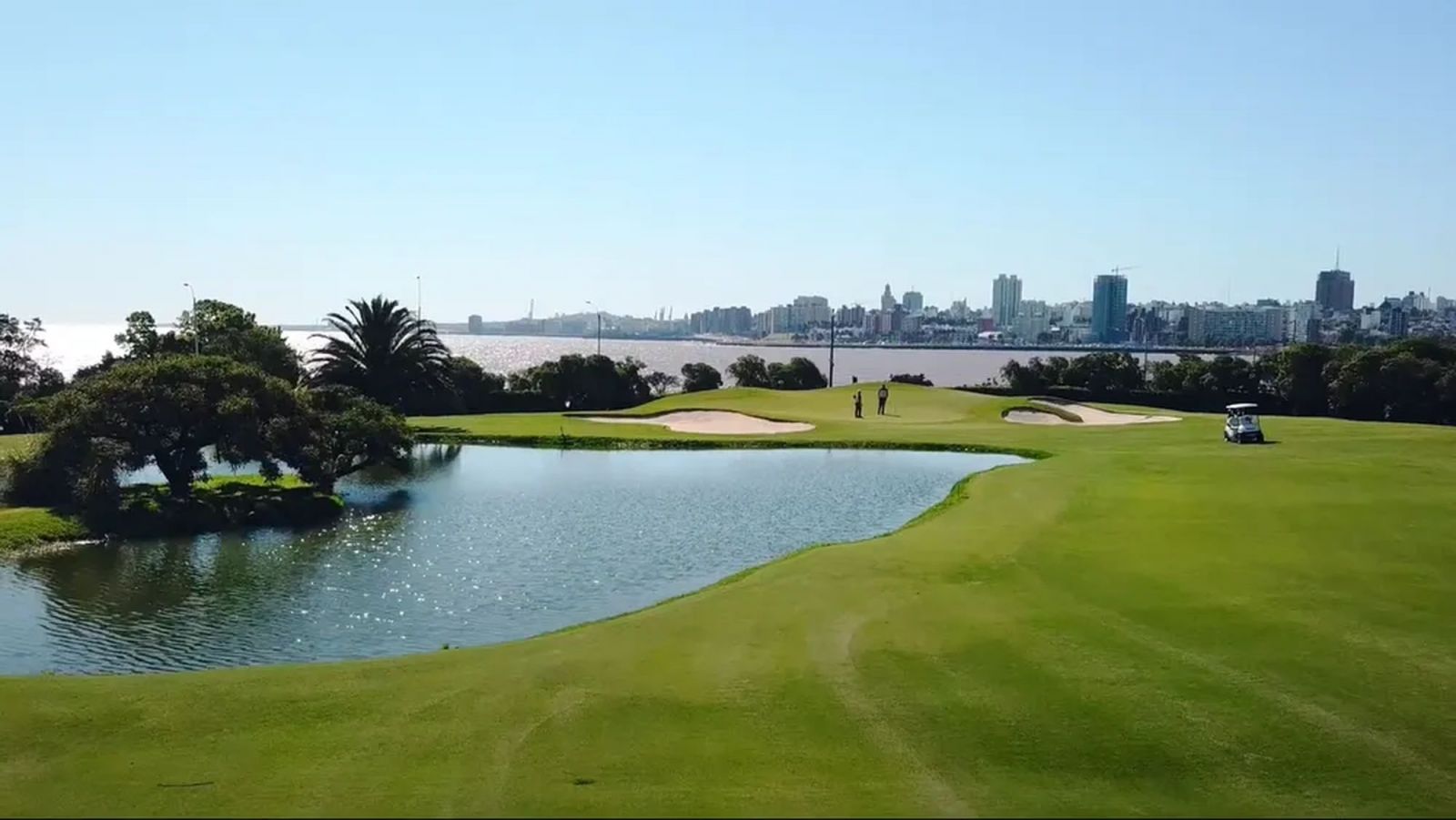
(The Club de Golf del Uruguay, in Montevideo, is a par 73 designed by Dr. Alister Mackenzie)
4. There should be little walking between greens and tees
("There should be little walking between greens and tees")
This is a major principle that is gradually being forgotten in modern golf, as many new courses are built to support real estate developments. This creates long distances between greens and the next tee, making walking more difficult. Golf should be conceived as a four-hour walk shared with friends. The walk between shots is a fundamental part of the enjoyment.
Many modern courses in the U.S. or Spain were designed to be played with golf carts, which goes against the nature of the game and also complicates logistics for hosting professional events.
5. Every hole should have its own character
("Every hole should be different in character")
Pine Valley, where Wegolf has played several times, is perhaps the most perfect example: no two holes are alike. Each has its own “personality” and requires a wide variety of shots. Every hole is extraordinary. Each one should be unique, demanding and forcing the golfer to think through every shot. Mar del Plata Golf Club is one of the most perfect creations in the world: a design on a very small piece of land with immense creativity to make it feel different every time it is played.

(Mar del Plata Golf Club sits on a small 20-hectare property)
6. There should be a minimum of blindness for approach shots
("There should be a minimum of blindness for the approach shots")
In traditional golf terminology, the “approach shot” refers to the shot played to the green—the first on par 3s, second on par 4s, and third on par 5s. What Dr. Mackenzie suggests is that golfers should be able to see the flag (the target) on these shots to avoid surprises and randomness. While there are many blind approach shots that remain interesting (such as “Spectacles,” the 14th at Carnoustie), it is generally best to see what you are aiming at. It is the fairest approach.
7. There should be infinite variety in the strokes required to play the various holes… (using every club)
("There should be infinite variety in the strokes required to play the various holes... (with every club utilized)")
Ideally, each hole should offer multiple ways to be played by the same golfer. A perfect example is the par-3 16th at Augusta National, where different green tiers create multiple pin positions. Combined with various tee angles and distances, a player might hit anything from a 9-iron fade to a 6-iron draw depending on the flag location. The Old Course at St Andrews, meanwhile, features a routing where 7 holes go out, then 2 return, then 2 go out again, and the final 7 come back. Playing with wind in the opposite direction creates two completely different courses. The same applies at Mar del Plata Golf Club: holes #8 (125 yds) and #12 (178 yds) share opposite ends of the same tee box—one plays south and the other north—so the same club may be used depending on wind direction.
8. There should be a complete absence of the annoyance caused by searching for lost balls
(There should be a complete absence of the annoyance and irritation caused by the necessity of searching for lost balls)
This does not mean eliminating hazards or preventing punishment for extremely poor shots. It means minimizing frustration caused by searching for or losing balls. Trees and wooded areas can add challenge without being overly penalizing. Augusta National and the Argentine Jockey Club are good examples: out-of-bounds areas rarely come into play, and players of any level are likely to finish their round with the same ball they started with.
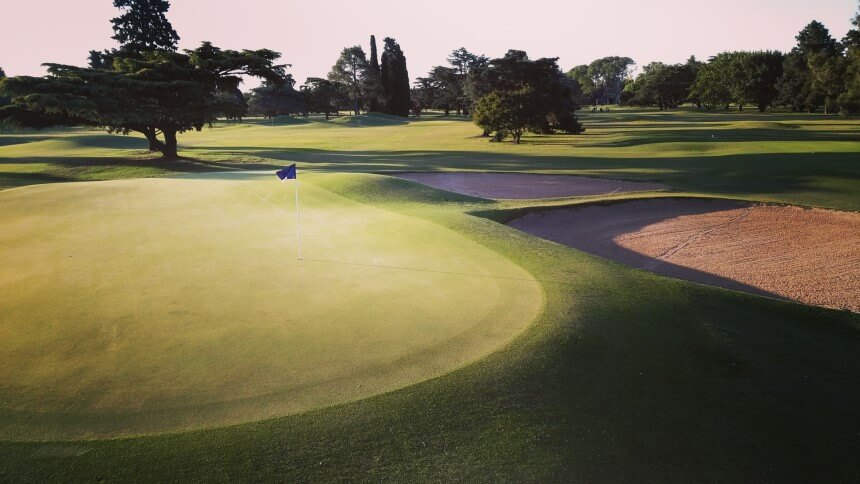
(The “Colorada” course at the Argentine Jockey Club has no water hazards)
9. The course should be so interesting that even the scratch player is constantly stimulated to improve
("The Course should be so interesting that even the scratch player is constantly stimulated to improve his game")
A golf course must challenge all players, from professionals to high-handicap amateurs, according to their skill level. The handicap reflects a player’s ability, and the course should match it fairly. This is achieved through tee placements that adjust the length of each hole. Many modern courses offer 4 or even 5 tee sets, ranging from 5,000 to 7,200 yards, allowing players to combine tees for their preferred total yardage.
Hazards and cross bunkers should penalize but still allow recovery, ensuring that a bad shot does not turn into a nightmare. Greens should offer a mix of easy, medium, and difficult pin positions. Even in the most important tournaments, not all 18 holes can have extremely difficult pins—players must occasionally be given the chance to attack.
10. The course should be designed so players of all levels can enjoy it, even with high scores
("The Course should be so arranged that (all levels of players can) enjoy the round in spite of ... piling up a big score")
This complements the previous principle: beyond good maintenance, the course must offer a level of challenge suitable for all players. It should entertain and challenge equally, whether scratch or high handicap. It is the player’s responsibility to choose the correct tee set to avoid a course that is either too difficult and frustrating or too easy and boring. The R&A recommends that amateurs play up to 6,000 yards, with only highly skilled players stretching to 6,500.
11. The course should be equally good in winter and summer, with consistent fairways and approaches matching the greens
("The Course should be equally good during winter and summer, the texture of the greens and fairways should be perfect and the approaches should have the same consistency as the greens")
A good golf course must be well maintained year-round. No season is an excuse for poor conditions. While maintenance work such as aeration and topdressing is necessary, once completed the course should be in excellent condition.
This requires different approaches depending on the region. In places like New York, courses such as Winged Foot, Shinnecock Hills, Oak Hill, Bethpage Black, or Liberty National close during winter due to snow. They use a single grass type that remains pristine from April to November.
In year-round golf destinations, winter overseeding is common on greens and tees, and sometimes fairways, as seen at PGA West or some Costa del Sol courses. While not essential, it improves aesthetics.
Tree selection is also important. Ideally, evergreen species should be used to avoid leaf drop that can clutter fairways and lead to lost balls.
12. There should be a sufficient number of shots requiring players to carry hazards
("There should be a sufficient number of heroic carries")
Every course should include shots that intimidate players and require them to execute their best swings to carry hazards. This must align with skill level, reinforcing the importance of tee selection. A “heroic carry” might involve flying a cross bunker for a better angle, as on the 18th at Mar del Plata, or even a short but intimidating shot like the 17th at TPC Sawgrass.
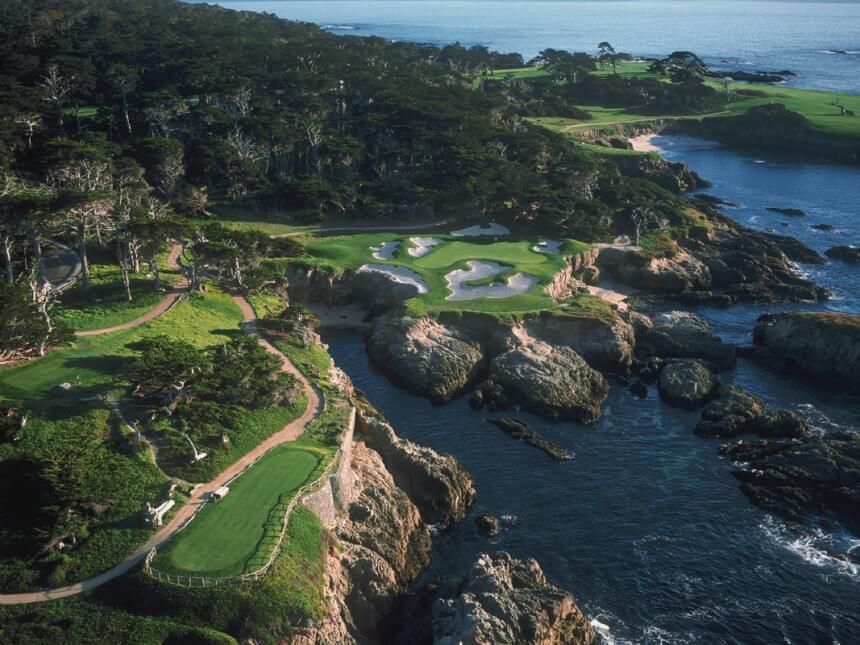
(The par-3 15th hole at Cypress Point, California)
13. Greens and fairways should be sufficiently undulating
("The greens and fairways should be sufficiently undulating")
Here, Mackenzie reflects his admiration for the Old Course at St Andrews: “only the hand of nature could have sculpted something so perfect.” He refers to its naturally undulating fairways (the 16th fairway at sunset is especially striking). While terrain provides the foundation, it is up to designers and shapers to create movement and avoid flat, monotonous layouts.

(The undulations of the 16th fairway at the Old Course)
On greens, designers must incorporate slopes and tiers to allow varied pin positions and avoid flat putts, making reading greens an additional challenge without excessive severity.
Mackenzie excelled in this, particularly with false fronts—areas where the ball will never stop and where a hole could never be placed—such as the front of the 14th at Augusta, the 12th at the Colorada course of the Argentine Jockey Club, or the front of the 16th at Pasatiempo.
When it comes to creative undulating greens, the Castle Course at St Andrews is a great example, although some consider it excessive.
These are the principles that Dr. Mackenzie, considered the “Designer of the 20th Century,” believed should guide the design of a golf course.
Related trips


Comments
-
liebre12/12/2024 13:11muy buena la nota y el recorte de los 13 principios!!. desde mi humilde opinion me parece que cuando se traduce sufficiently"a suficiente entiendo que en ingles intenta decir no muchos" solo algunos o no en exceso. se puede mal interpretar en la traduccion. Y tambien en la foto donde dice uruguay debajo de la foto pero es MDQ. Mackenzie tambien decia, para mi de lo mas importante, es que las canchas no deberian tener fairways dibujados o encasillados en forma de pasillos de arboles. que arboles tiene que haber pero salteados y que no delimiten fairways.
-
Vicente M.A. Falaschini27/05/2020 17:22Muy buen ejemplo el del 8-12 de PLaya Grande. He jugado muchos años alli y sucede tal cual lo menciona. Muy linda nota para leer.
-
Alister Mackenzie12/05/2020 11:55Muy linda foto del 15 de Cypress. Pocos saben del tee original que apenas se ve sobre la izquierda, un ángulo un poco menos complicado y desde donde se ve menos del Océano.
Leave us your comment
Your email will not be published
I want to suscribe
Featured posts

About the History of Augusta National Golf Club

Top 5: Our Selection of Destinations for Your Next Golf Trip

The Open 151: From the Inside

Wegolf Top 10 Playable Golf Courses in the World

How can you play at Augusta National?

Top 10: The Best Places for a Golf Trip in the USA
