


 : (+54911) 7213 6798
 The stories behind golf
How did golf begin? Why is it played over 18 holes? Why is the hole 4.25’’ in diameter? Every detail has a story, and every story gives meaning to the present.
In an exclusive interview with Wegolf, Connor T. Lewis, member of the Society of Golf Historians, shared with us different facts about the history of our sport.
When you really take the time to think about it, golf, at its core, is a fun game. We hit a small ball with clubs with the sole objective of getting it into a slightly larger hole in the ground. But many of us don’t take the time to think about why we do it. Why we play 18 holes, why that hole size, why we only use 14 clubs. This article won’t answer every question, but hopefully it will help you better understand the strange yet fascinating game of golf.
How did golf begin?
It’s a question golfers have been asking for over 200 years. In Scotland they claim to be the creators of the game, and rightly so. Golf originated on the sandy soils of Scotland, but it is likely related to another game. Most historians believe golf evolved from a Dutch game called Kolven. It was a game in which a player had to hit a ball with a stick toward a target post sticking out of the ground, often played around lakes and frozen ponds in winter. The game of Kolven likely reached Scotland in the 14th century through maritime trade. Near Scottish ports, Dutch sailors entertained themselves during downtime by playing this stick-and-ball game. Without frozen ponds, this pastime evolved into a game played on land — and thus golf was born. Kolven was also known as Kolf. It is said that in translation the word Kolven may have been “lost,” or that Scots interpreted Kolf as Golf. In fact, Kolf means club.
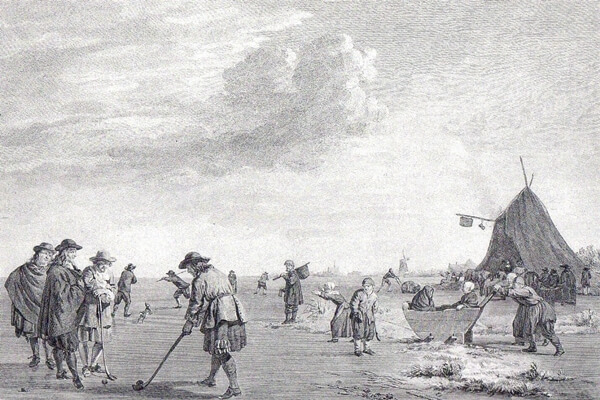
Kolven was a game played in Holland using a stick and a ball.
Why do we play 18 holes?
18 holes may seem arbitrary. Wouldn’t 15 be better? Or 20, since it’s a round number? If you’ve ever listened to caddies at St. Andrews, they might tell you we play 18 holes because a bottle of whisky has 18 shots. My advice: listen to your caddie when choosing a club — but remember their stories often contain more folklore than fact.
The real reason is almost as random as the history of golf itself. Early golf courses, before The Open Championship began in 1860, varied widely. The Old Course at St. Andrews had 22 holes, Musselburgh Links (which hosted six Opens) had just 8 holes until 1870, Prestwick had 12 holes, and Leith Links had only 5. So why 18? The answer lies in the combination of the R&A, the Old Course, and the legendary Old Tom Morris — all centered around St. Andrews. The R&A was the governing authority, the Old Course was considered the best in the world, and Old Tom Morris traveled extensively designing courses, most of them with 18 holes. Over time, St. Andrews became the standard-bearer, and 18 holes became the norm. It’s worth noting that the original Open rota included Prestwick (12 holes), St. Andrews (18), and Musselburgh (9).
.jpg) The first Open Championship was played at Prestwick in 1860.
The first Open Championship was played at Prestwick in 1860.
Why is the hole 4.25’’ in diameter?
You might be surprised to learn that it wasn’t always this size. In fact, there was no standard for many years. The hole size wasn’t standardized until 1891, meaning that for the first 30 years of The Open Championship, holes could vary in size between courses — or even within the same course. But the reason for this specific size is even more interesting.
If you’ve ever had putts lip out, you can blame one person: Robert Gray. In 1820 at Musselburgh Links, a local golfer and blacksmith was asked to create a liner for golf holes. Instead of reinventing the wheel, Gray used a section of drainage pipe commonly used for rooftops. That pipe happened to measure 4.25 inches in diameter. The first official hole cup was made in 1829 at Musselburgh, but it took another 62 years for this size to become the standard.
Golf history is rich, and much of it is shaped by chance. If the drainage pipe had been 5 inches instead, many missed putts might have dropped. And if the R&A had been based at Leith Links, would golf be played over 5 holes?
Golf, like life, has evolved over time. When you trace its origins, you uncover stories that are often as entertaining as they are surprising.
*Connor T. Lewis is host of the TalkingGolf History Podcast and a member of the Society of Golf Historians.
*Wegolf distances itself from the author’s opinions.
Comments
-
Hernan Fitte19/05/2020 09:44Se sabe porqué 14 palos? Muy interesante seguir con estas nota, así como las entrevistas en Ig
-
Cesar Gonzàlez19/05/2020 08:46Yo sabia que lo inventaron los pastores de ovejas en escocia, mientras ellas comían los pastores para no aburrirse hicieron una pelota y le pegaban con un palo
-
Diego Martínez18/05/2020 18:36Qué buena nota, muchos creíamos que eran 18 hoyos por las 18 medidas de whisky. Gracias por el aporte!
-
Alberto Agrest18/05/2020 17:46Connor y su podcast nos han estado mostrando muchos de los hitos de la historia del golf. Muy buen resumen de los verdaderos principios de nuestro juego!
Leave us your comment
Your email will not be published
I want to suscribe
Featured posts

About the History of Augusta National Golf Club

Top 5: Our Selection of Destinations for Your Next Golf Trip

The Open 151: From the Inside

Wegolf Top 10 Playable Golf Courses in the World

How can you play at Augusta National?

Top 10: The Best Places for a Golf Trip in the USA
