


 : (+54911) 7213 6798
 Oakmont, the Toughest Golf Test in the USA
In a first-hand account, Javier Pintos, Director of Wegolf, tells us what it is like to play at Oakmont Country Club. An experience for all the senses.
Oakmont Country Club is one of the best private golf courses in the world (ranked in the top 5 in the USA for decades) and, along with Carnoustie, one of the toughest tests faced in professional Major championships.
Because of this, driven by my desire to play and discover the best courses in the world, and my passion for golf design and history, visiting that club had been on my mind since 1994, when Arnold Palmer decided to play his final U.S. Open and a young Ernie Els burst onto the scene to win the first of his four Majors.
In 2007, something so significant happened for Latin American golf (combined with my admiration for Ángel Cabrera) that my desire to visit Oakmont multiplied. Slowly, with patience and creativity, I looked for a way to gain access to one of the most exclusive private clubs in the USA.
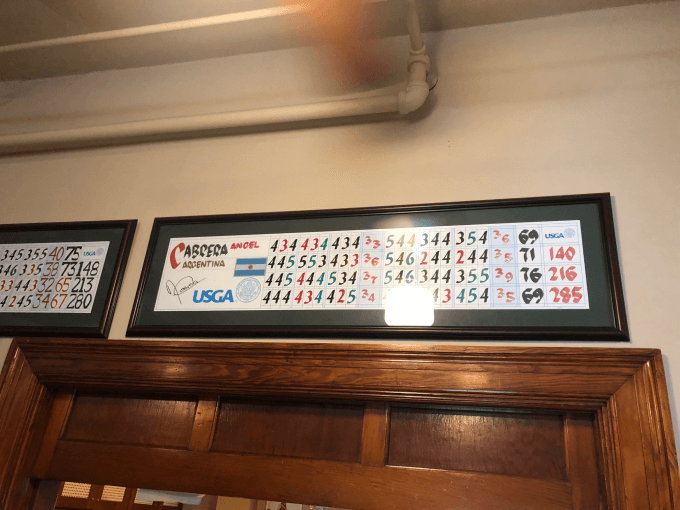
Cabrera was the only player to shoot under par twice at the 2007 U.S. Open
The 2007 edition of the U.S. Open at Oakmont sparked immense admiration in me for the course. That year was played under extremely difficult conditions, and the results reflected it. The winning score was 5 over par, and the cut was 10 over par.
It wasn’t just the golf challenge that drew my attention. Oakmont is a club designated as a “National Landmark” (historic monument), a course that has been special since its inception and, not by chance, has produced great champions. After having the chance to visit and play it twice, I can guarantee that everything said about it falls short. “Oakmont could host a U.S. Open tomorrow”, said Lee Trevino—and he wasn’t wrong.
As often happens in these situations, a series of fortunate events and people I was lucky enough to meet throughout my career at Wegolf made my access possible in the best way, as I was invited by Bob, the head Pro there and at Seminole, and Chick, a former President and multiple Oakmont champion. Being invited to a place like this is not something that happens often, and it is also a personal challenge: you have to be ready to make the most of so much history in such a short time.
Getting to know the club is important. During his visit to Argentina (a few months earlier to play at Jockey and Olivos), Chick brought me a book about the club. Reading it helped me understand how the place had evolved since its beginnings, how the course developed, and how after the 1994 Open they wisely decided to restore it to its original state, removing more than 4,000 trees that had been planted and had nothing to do with Henry Fownes’ original design.
Golf has taken me to many special and hard-to-access courses, and the experiences have been varied. What made my visit to Oakmont (and others like Pine Valley, Merion, or Shinnecock Hills) unique was that it wasn’t just a round of golf—it was a three-day weekend where I was able to fully experience everything.
I arrived in Pittsburgh on a Friday at noon and, on my way to Oakmont, I had the incredible opportunity to play at Fox Chapel (a masterpiece by Seth Raynor). It was the perfect warm-up before arriving at the club later that afternoon around 6 pm, when my legs were literally shaking with excitement—I was about to fulfill perhaps my greatest dream as a golf lover.
That first afternoon, I was able to see some details of the Club House, walk the greens of holes 9 and 18, and enjoy the “19th hole” after the SWAT season-opening event, sitting at a large table full of lively and talkative golfers. Every phrase they spoke carried a lesson. I was tired, but all my senses were focused on absorbing every minute of the weekend to store it forever in my memory.
I spent the weekend at Chick’s house, almost as an honored guest. Asking for more would have been selfish: we left the club, and dinner with his family made me feel right at home.
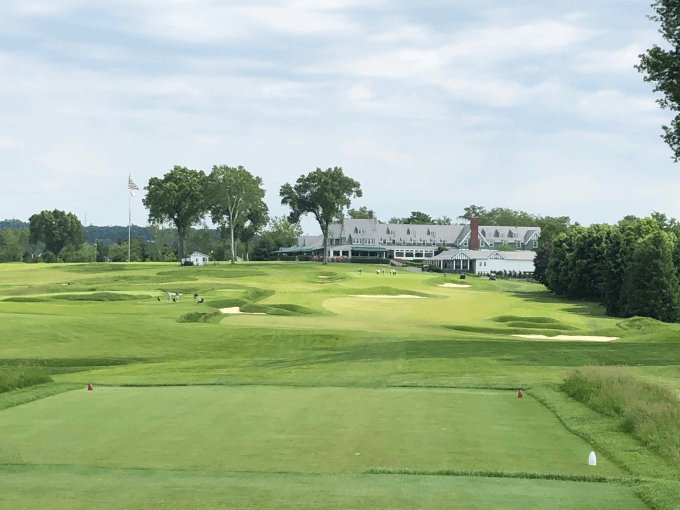 Hole 18 at Oakmont, remembered for Cabrera’s phenomenal drive to win the 2007 U.S. Open
The weekend was complete. Touring the clubhouse on Saturday morning was important to see how a club values its history and the events that have taken place over more than 100 years. Memorabilia from each U.S. Open champion is carefully selected, and every photo has a reason to be there. Of course, Cabrera’s display was the most special, including cigarette butts from that final round. There is also a photo of Cabrera pointing at Tiger and laughing with Furyk. Chick explained the joke: “I’ll bet you won’t name your daughter Angel”, Furyk told Woods, referring to his daughter Sam Alexis, who would be born the next day.
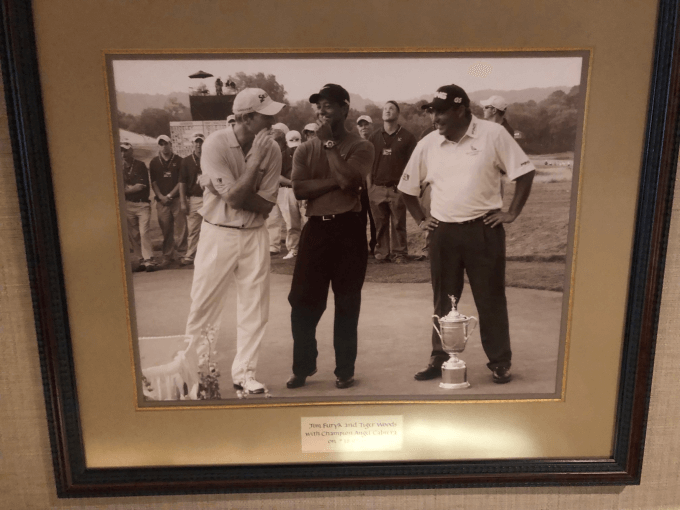 Furyk, Woods, and Cabrera during the 2007 U.S. Open trophy ceremony
After the clubhouse tour, it was off to the putting green and then to play. About my performance in that first round, I’ll just say everything went wrong—but it hardly matters. We played the club’s classic SWAT event, which is another honor: being invited to one of the most important open events of the season.
After the round, the late lunch at the club was very special and included a visit to the locker room to see the location of the iconic photo of Ben Hogan exhausted after winning the 1953 Open.
Chick is still a great golfer today, even at nearly 70 years old. Cindy—his wife—is not only a good golfer but also an excellent cook, and baked salmon was the perfect ending to the day despite the many bogeys. While preparing dinner and discussing the round, Chick showed a very paternal side: he helped me reflect on where I had gone wrong, which shots I should have approached differently, and how to tackle the second round the next day. And it worked!
On Sunday, I played my second round on a completely different course. Saturday had been firm and fast, with greens—according to Chick—even faster than during the 2007 U.S. Open. Overnight and into Sunday, it rained and the wind shifted. The course played much longer, and the greens were softer.
I didn’t have much time after the round other than a quick lunch and recreating the classic Hogan photo completely exhausted. Sometimes fatigue is physical, and sometimes emotional. In this case, it was emotional—the experience had been far more intense than expected.
The course:
Chick told me that Fownes was inspired by Carnoustie when creating Oakmont (his only design). Both courses share many similarities: the downhill second shot on hole 1, short par 4s like Oakmont’s 2 compared to Carnoustie’s 3, the par 3 on 8 similar to Carnoustie’s 16, and both have long and difficult 18th holes. There are many details, even in bunker and green design, that make them “sister” courses separated by the Atlantic Ocean.
It is often difficult to fully appreciate the characteristics of courses we only see on television. This happens with Augusta and its elevation changes, and the same applies to Oakmont’s greens, which are among the best and most demanding in the world. Similarly, there are shots on this course near Pittsburgh that television simply cannot do justice to, such as the uphill climb on hole 3, the size of the “Church Pews” cross bunker separating holes 3 and 4, or the steep rise on hole 9. The rough is not impossible: the ball can always be found.
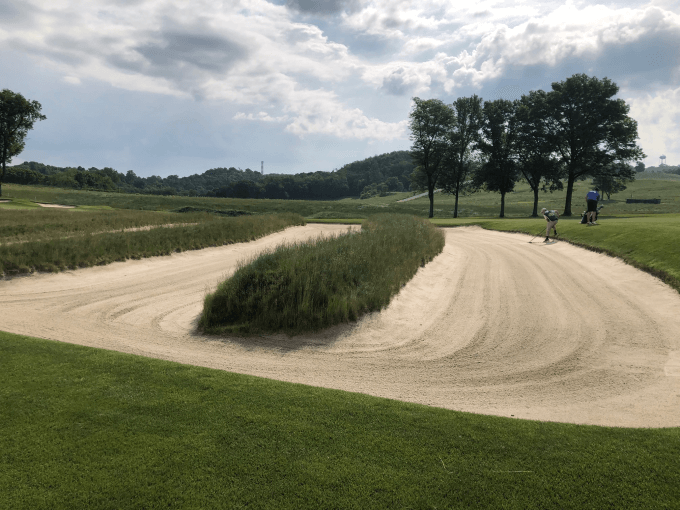 The famous “Church Pews” cross bunker separating the fairways of holes 3 and 4
One of Oakmont’s masterful details is that the longer holes play downhill, while the shorter ones play uphill. Even in that, the genius of Henry Fownes was evident.
It is a work of art, whose bunkers originally featured deep grooves created by special rakes, making them the ultimate punishment for a missed shot. One bunker still maintains this style, the one to the left of the 14th green. I had the chance to lift those rakes and notice how heavy they are.
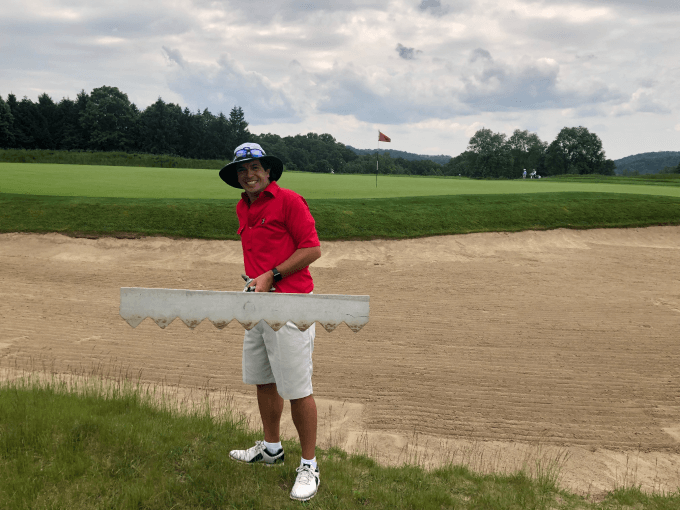
This large rake is used to create deeper grooves in the bunkers, making the lie more difficult when the ball lands there
Oakmont is special—for a reason it has been declared a National Landmark. Having had the chance to experience it over three days is something I could not be more grateful for. Opportunities like this sometimes come once in a lifetime, and in my case, it happened at just the right moment. The club is special, but the course even more so—and together they create what may be the best golf experience in the USA for those of us who truly love and live the game intensely.
* Javier Pintos is Director of tailor-made trips at Wegolf and has played 9 of the top 10 golf courses in the United States.
¿Were you familiar with these stories about Oakmont Country Club?
¿Which moment do you remember most from Ángel Cabrera’s victory here?
Comments
Leave us your comment
Your email will not be published
I want to suscribe
Featured posts

About the History of Augusta National Golf Club

Top 5: Our Selection of Destinations for Your Next Golf Trip

The Open 151: From the Inside

Wegolf Top 10 Playable Golf Courses in the World

How can you play at Augusta National?

Top 10: The Best Places for a Golf Trip in the USA
